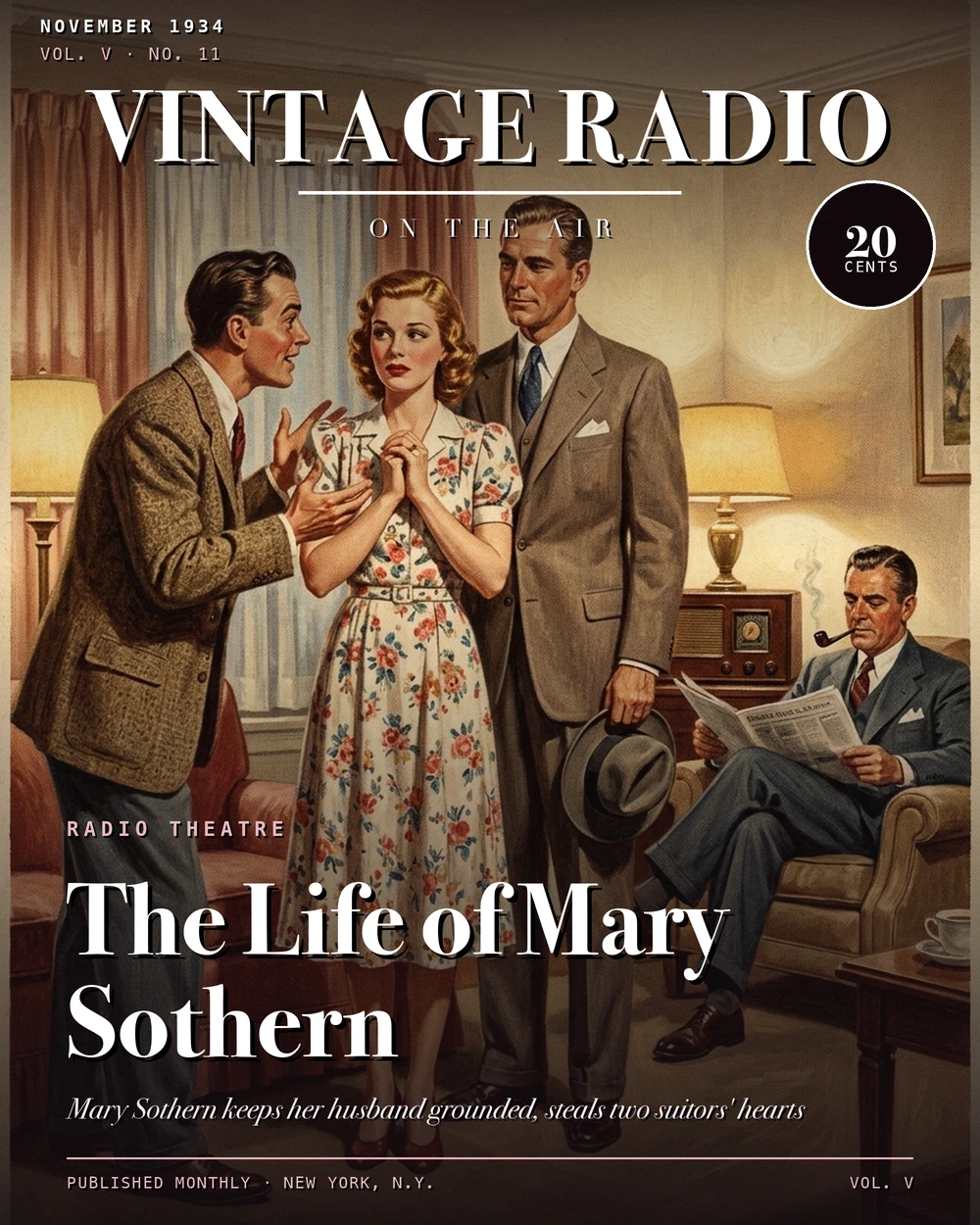
The Life of Mary Sothern
The Premise and the People
The central joke of The Life of Mary Sothern was right there in its own description: a young mother struggling to keep her "well-meaning husband's two feet on the ground." It's a setup that tells you a lot about what daytime audiences in the 1930s were expected to find relatable — a capable woman managing an idealistic, impractical man while the world moved on around her. The show ran from 1934 to 1943, a solid nine-year stretch that took it through local radio, two networks, and eventually a transcribed life on independent stations across the country.
Three actresses rotated through the lead role over the years — Minabelle Abbott, Fran Carlon, and Betty Caine all played Mary Sothern at different points. That kind of casting turnover was common in the daily grind of serial production, and it speaks to how long the show stayed in continuous production. The character of Danny Stratford, presumably Mary's husband, also cycled through performers: Jack Zoller, Joseph Julian, and Leon Janney each took a turn. Janney was the most unlikely of the three — a former child star who had made his film debut in Victor Sjöström's The Wind opposite Lillian Gish, and who headlined the 1931 adaptation of Booth Tarkington's Penrod and Sam before he was old enough to vote. He brought a Hollywood résumé into daytime radio and went on to play Lee Chan on The Adventures of Charlie Chan and the lead on Chick Carter, Boy Detective.
The Love Triangle
The more interesting dramatic machinery in the show was the rivalry between Max Tilley and Dr. John Benson for Mary's affections. Jay Jostyn played Tilley, described as "impulsive," while Jerry Lesser played the more measured Dr. Benson. The two competed in what was characterized as a "good-natured rivalry" — which in soap opera terms probably meant plenty of tension without anyone turning villainous. Tilley ultimately won Mary's hand. Florence Golden played Danny's wife Phyllis, rounding out the domestic web that these characters moved through.
Jostyn was a Milwaukee native — born Eugene Josten — whose own radio career had started at WLW in Cincinnati, the same station where Mary Sothern originated. He was an early voice on the late-night Moon River program there, reading poetry, before he joined this cast and eventually graduated to the title role in Mr. District Attorney, which he held from 1940 to 1952 and is best remembered for. Frank Lovejoy, who would go on to a substantial career in radio and film, appeared here in the supporting role of Chaney. Ken Roberts served as announcer. The show was written by Don Becker and directed by Chick Vincent. Its theme song was "Just a Little Love, a Little Kiss" — a title that fits the show's tone better than any summary could.
How the Run Broke Down
The Life of Mary Sothern started at WLW in Cincinnati in 1934, picked up a Mutual network run from November 4, 1935 to April 30, 1937, airing on weekdays at 4:15 in 15-minute episodes. Hinds Honey and Almond Cream sponsored the Mutual broadcasts, and the same sponsor followed the show to CBS when it moved there on October 4, 1937, now airing at 5:15. The CBS run ended April 22, 1938. From 1939 through 1943, the show continued as a transcribed program — pre-recorded episodes distributed to independent stations — which was an increasingly common way to keep a serial alive after network commitments ended.
More than three hundred episodes were produced across the run, and a respectable fraction of that has survived: somewhere between 218 and 237 recordings, totaling roughly forty hours of audio. Dates and episode numbers were not preserved with most of the surviving copies, and the audio quality of the circulating recordings has been described as "average at best." A Minabelle Abbott Collection also exists in the Radio Preservation Task Force's archival holdings — a quiet acknowledgment that the woman who originated the title role left enough of a trail to be worth preserving on her own terms.